


Denmark’s Electronic Research Library

Colophon
Title:
Denmark’s Electronic Research Library
Summary:
Denmark’s Electronic Research Library - profile
Publisher:
Denmark’s Electronic Research Library / Danish Agency for Libraries and Media
Responsible institution:
Denmark’s Electronic Research Library / Danish Agency for Libraries and Media
Author:
Denmark’s Electronic Research Library / Danish Agency for Libraries and Media
Language:
English
URL:
http://www.bibliotekogmedier.dk/fileadmin/publikationer/publikationer_engelske/deff/profile/index.htm
ISBN:
978-87-92057-70-9
Digital ISBN:
978-87-92057-71-6
Version/edition:
16-09-2009
Data formats:
html,htm,jpg,gif,pdf,css,js
Publisher category:
statslig
Contents
Preface
About DEFF
Organisation
- Coordination committee
- Steering committee
- Secretariat
- Programme areas
- Action lines of the programme groups
Strategic action lines
History
International cooperation
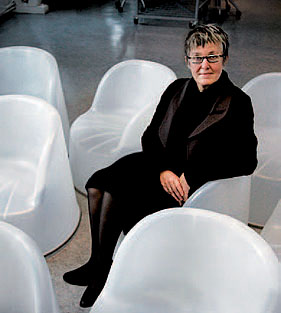
Mai Buch, managing director Competencehouse A/S:
"Accessibility and application of scientific information is to me absolutely central in a knowledge society and vital in terms of Denmark’s competitive power.DEFF therefore has an important task in relation to the development of the Danish knowledge society, a task I look forward to sharing with the new DEFF steering committee."
Excerpt from text concerning DEFF in Finance Act 2009"Denmark’s Electronic Research DEFF provides funding for Library (DEFF) is an organisational and projects, development of the technological collaboration between the research administers joint purchases and education of Science, libraries, co- may provide subsidies for Technology and Innovation, Ministry of Education and Ministry of DEFF negotiates and signs Culture. DEFF’s objective is to further licenses on behalf of the the development of a network of electronic libraries Danish Agency for Libraries that make their electronic and information resources the secretariat for the available to the users in a cohesive and simple way.
DEFF provides funding for joint development projects, development of the infrastructure and administers joint purchases of licenses. DEFF may provide subsidies for international activities.
DEFF negotiates and signs contracts for electronic licenses on behalf of the research libraries. The Danish Agency for Libraries and Media provides the secretariat for the collaboration”.
”A research library can be a pivotal point for establishing contact or making visible the knowledge that exists.”
Hans Müller Pedersen, deputy director in the Research and Innovation Agency, from interview in connection with Fremtidens biblioteksbetjening af Forskere (Future library service to researchers).
Preface
We live in a global world where we communicate, cooperate and do business with almost every country in the world. This presents us with a number of new challenges and possibilities. In Danish glo-balisation strategy it is being stressed that we can only meet these new challenges and exploit the possibilities if everybody is given “the best conditions for exploiting their capabilities and creating progress for themselves and for others”. This means that in the future we must invest in education, research and innovation.
This is where Denmark’s Electronic Research Library (DEFF) and the libraries are given a specific role. The libraries are an important part of the infrastructure that supports research, innovation and education. The traditional role as information supplier will to an increasing degree have to be supplemented by new functions that help scholars, educators, young people in education and companies to transform information into knowledge. Concepts such as electronic publishing, research registration, virtual learning spaces, virtual innovation spaces and information literacy are taken up ever more space in the library’s “job” description.
More and more library services are becoming digital, and the Internet is an important platform for the solution of the many new tasks. DEFF has in 2009 been extended to include all pupils and students in upper secondary education, business education programmes and higher education programmes. This means that the majority of our future work force can grow up with experiences and competences that enable them to take advantage of the great knowledge which the library cooperation offers.
The great demands levelled at research, education and innovation over the coming years entail that library service must be consolidated and developed so as to contribute to the Danes being able to work interactively and innovatively with knowledge both in local and global fora. As cooperation organisation for the research libraries DEFF has provided the framework for this development for more than ten years and looks forward to delivering the solutions which will place the libraries centrally as part of the infrastructure for research, education and innovation”.
Mai Buch
Managing Director Competencehouse A/SChairwoman, DEFF steering committee ”There needs to be a national policy agency that can communicate to the decision makers the importance of the basic information skills and about the integration of services”
Chris Batt, Chris Batt Consulting, from interview in connection with the project Fremtidens biblioteksbetjening af forskere

About DEFF
DEFF aims to make sure that scholars, educators and students have access to all relevant information via user-friendly systems and guidance of excellent quality. The aim is to support all aspects of the scholars’ and students’ work with information resources at the highest international level. DEFF contributes to the optimal exploitation of research-based information resources and this happens through cooperation between the library partners, common development projects as well as the establishing of a technical infrastructure.
DEFF’s target group is mainly serviced directly via the institutions that participate in DEFF, and through common services where this is expedient.
DEFF has three overall goals. Firstly, DEFF must improve the end-users’ exploitation of electronic resources, qualitatively as well as quantitatively. Secondly, the cooperation between the research libraries must be strengthened and made to include new cooperation partners. Finally, the results must be documented, mediated and spread to the public.
DEFF is a cooperation organisation for Danish educational and research libraries. The cooperation includes joint development in those cases where cooperation yields better results than the sum of local initiatives. This guarantees a better collective exploitation of the libraries’ resources. DEFF must also ensure further development of the common network of information resources, and there must also be a collective mediation of the information resources of the educational and research libraries to the public.
Participants
The DEFF cooperation includes the majority of the about 500 libraries that service scholars and students:
- The university libraries, e.g. Aalborg University Library
- Other specialist and research libraries – libraries that service institutions with specific research or analysis tasks, e.g. the Danish Road Directorate Library as well as a number of libraries in connection with private companies
- Libraries at the university colleges – libraries at medium-length education programmes, e.g. teacher training and pedagogue training
- Upper secondary educations, e.g. gymnasiums, SOSU educations (social and health colleges), business and technical colleges.
Target group
DEFF’s primary target group is scholars, educators and students at educational institutions with medium-length and further educations and at sector-research institutions. The target group is characterised by having need of DEFF’s information resources at e.g. research-based commercial companies and research parks, hospitals and institutions with shorter education programmes. Apart from that DEFF contributes to the mediation to the public of the information resources of the educational and research libraries.
Theme: Research and education
In a knowledge society research and educational institutions play an important role as producers of knowledge and competences. Despite the increasing impact of the Internet, both as medium and source of information, both research and education continue to be very dependent of libraries in order to function.
The notion that the Internet as information source is sufficient to conduct research and education involves the risk of the library’s importance to research and education being underestimated.
Research is cumulative – it is all-important to build on existing research results. This presupposes that one can indentify the latest research results, that one can trust them and can gain access to them. This is where the libraries play an essential role. The libraries also play an increasingly greater role in terms of the output from the research processes where activities like research registration and Open Access are by now central tasks for many libraries.
Education is becoming ever more problem and project oriented. The students learn to formulate the questions themselves and answer them via project work. The learning moves out of the classroom and in many cases into the library in learning spaces and reading rooms. Teaching materials must be available via the Internet, and the Internet itself becomes an important tool in the learning process. Apart from handling digital education materials the libraries must also via training in information literacy contribute to making sure that the students can use the Internet critically and efficiently and in this way lay the foundations for lifelong learning.
The libraries that support higher education and research are called educational, specialist and research libraries.
Organisation
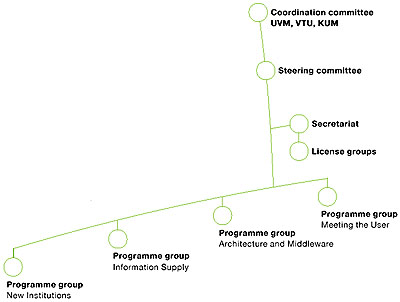
Coordination committee
The overall management of DEFF is handled by an inter-ministerial coordination committee representing the Ministry of Culture (KUM), Ministry of Science, Technology and Innovation (VTU) and Ministry of Education (UVM). The coordination committee has the overall decision-making competency for DEFF as a whole. The committee makes overall decisions concerning DEFF’s strategy and development plan as well as the relevant budget framework.
Steering committee
The steering committee develops DEFF’s overall strategy and approves strategy, action plans and projects from the programme areas.
Secretariat
Secretariat function and the daily administration of DEFF are placed in the Danish Agency for Libraries and Media.
The secretariat’s areas of responsibility include administration of licenses, projects, homepage and servicing coordination committee, steering committee and programme areas.
Organisation diagram for DEFF
Programme areas
The programme groups consist of central members of staff from various libraries. The programme areas prepare a strategy and action plan and submit it to the steering committee. These action plans form the basis for the concrete implementation of the strategy and for budgeting. The programme areas can apply to the steering committee for financial support for activities. The work in the programme areas is organised in the four programme groups:
- Information Supply
- Architecture and Middleware
- Meeting the User
- New Institutions
Each programme group has defined primary action lines in the area’s strategy and action plan.
Action lines of the programme groups
Information Supply
- Global information supply
- Research publication and open access
- Research data and open access
- Teaching materials and open access
Architecture and Middleware
- Consolidation of IT systems
- Integrated search
- Technical infrastructure
Meeting the User
- Potentials in the exploitation and usage of web 2.0 in DEFF libraries
- Knowledge about methods for identifying user behaviour and needs
- Development of applicable web 2.0 products which are to be implemented and evaluated
- Strengthened knowledge sharing, including working towards a development culture in the DEFF libraries that increasingly involves the staff
New Institutions
- Communication
- Information supply
- Information literacy
- E-learning
- Knowledge management
License area
The purpose of the license work in DEFF is to procure as much relevant, electronic information as possible for scholars, instructors and students within the budgetary framework of the institutions. A license is in this context a designation for an agreement on access to electronic resources on certain conditions. The acquisition happens in a national cooperation in order to streamline the purchase process and the administration of licenses as well as in order to obtain as much information as possible at the lowest possible cost. International cooperation also takes place in order to obtain the best possible prices and conditions.
The area is organised in the two license groups: License group for Educational Libraries (LUB) and License group for University and Research Institutions (LUF).
The license groups strive to ensure access to licensed material both during the license period and after it expires. The purchased materials are registered in local catalogues as well as in a common collective registration list and must also be searchable via user-friendly systems with focus on electronic journals and databases. Via the DEFF license cooperation you gain access to about 25,000 scientific journals.
Action lines of the license groups
- Optimization of license management
- Securing of contributions to the Danish data well in the form of metadata and/or full text data in connection with license negotiations
- More licenses where Open Access is included in the financing
- Access to more e-books, including coordination of initiative and increased mediation
Theme: Digital information
Danish research is becoming cheaper to buy access to one- more and more international and Danish nals for one year at a time and foreign databases as well as electronic journals are central sources. Similar conditions The foreign publishers apply to higher -nationalare education programmes which - companies which in most cases are also research based.
Electronic journals are typically produced by publishers who provide these in packages. The Dutch publishers, Elsevier, for example, offer access to about 2,000 different journals. The journals are not freely available on the Internet. You buy a license (permission) to give access for the institution’s scholars and students to use one or more of these journals via the Internet. As a single article in a journal may cost as much as 30$, it is as a rule much cheaper to buy access to one or more journals for one year at a time.
The foreign publishers are multi-national companies which in most cases have monopoly status. It is therefore desirable for buyers to join together in consortia when negotiating and purchasing the electronic products.
The purchase collaboration is composed of a large number of consortia that subscribe to various journal packages. The collaboration includes about 180 different publishers and more than 200 institutions. An institution typically participates in many consortia and has a unique product portfolio composed of packages from the various publishers.
”Each individual library needs to think about its distinctive impact and consider whether it needs to spend a lot of time doing things that everybody else is doing pretty much identically. It makes sense to move shared activities into a shared environment, whether this is DEFF or some other approach. At the same time, what added value can be created for local learning and research activities?"Lorcan Dempsey, Vice President and Chief Strategist of the Online Computer Library Center (OCLC), from interview in connection with the project Fremtidens biblioteksbetjening af forskere
The research libraries’ purchases of electronic resources through DEFF 2001-2008
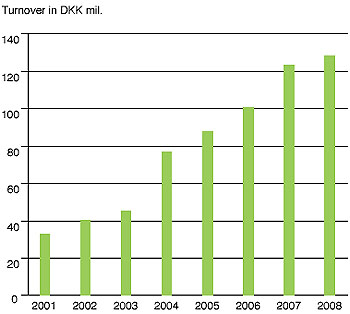
Figure 1 shows the development in the turnover in the license cooperation from 2001-2008. As it appears, the turnover has been increasing steadily and has now topped DKK 128 mil. annually. This trend is expected to continue at the same rate.
16 major research libraries’ downloads and loans 2001-2008
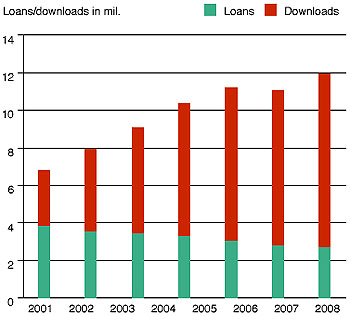
Figure 2 shows the development in downloads compared with loans of physical material measured in the 16 largest research libraries in Denmark. It appears that the loan of physical material has fallen during the period 2001-2008, while downloads have increased considerably and now make up about 3/4 of the total loans.
Strategic action lines
Consortia agreements
DEFF’s purchasing cooperation on electronic journal subscriptions and databases means an administrative relief for the individual library. The cooperation also gives the individual library the chance to enter into consortia with other libraries about the purchase of certain information resources.
The consortia agreements make it possible for all the participating libraries to gain access to the collective number of each library’s subscriptions without having to pay for all the journals. It is important because analyses of the usage show that researchers and students to a great extent use articles that are outside the institutions’ own subscriptions. This indicates a considerable interdisciplinarity within the institutions’ fields of activity and underlines the advantage in making consortia agreements.
The Wiley agreement is an example of Big Deal agreement. Via the consortia agreement the individual institutions get access to the collective number of titles. The DEFF license secretariat annually negotiates 250 license agreements for 200 institutions in Denmark.
Open Access
Bearing in mind the large investments in research it is important to promote free access to publicly financed research. This is i.a. done by supporting initiatives within Open Access, including encouraging the institutions to formulate publishing policies that further this objective.
DEFF supports open access-publishing through membership of SPARC. DEFF is moreover generally a central player in the Danish Open Access cooperation and contributes to the international Open Access endeavour.
Integrated search
The basis for integrated search is that data from many sources are collected and processed so that search engines can search in data and immediately afterwards present them to the user in a structured and uniform way. This collection of data is called a data well which to the greatest possible extent is made available to all libraries in DEFF. This work is complicated and technically demanding, and DEFF therefore supports joint cooperation within this area.
”The library has multiple identities. It is a building or buildings on campus. It is collections. It is a set of services delivered in a variety of ways. It is a group of people with particular expertice. Communicating this full spread effectively is difficult but increasingly important.”
Lorcan Dempsey, Vice President and Chief Strategist of the Online Computer Library Center (OCLC), from interview in connection with the project Fremtidens biblioteksbetjening af forskere
History
DEFF started in 1998 as a five-year project with the aim to give scholars and students at universities and institutions of higher education easier access to electronic resources. DEFF was established as a permanent activity in 2003 and these initiatives were extended with focus on output from the research process in the shape of research registration, Open Access and the Danish Research Database.
International development and the latest international review of DEFF indicate that the libraries, too, can play a valuable role in the research process. The libraries’ support of new learning processes and of information literacy therefore offers new opportunities to support the actual learning process. In terms of research there is increased focus on the support of e-science and on helping scholars structure and visualise primary research data and couple these onto subsequent research publications.
DEFF was originally intended as a project to help the libraries through a transition from printed media to digital mediation via the Internet. Today DEFF defines itself as a cooperation organisation for educational, specialist and research libraries.
DEFF was launched as initiative 10.3 in the report Info-samfundet for alle – den danske model (The info-society for everybody – the Danish model), prepared in 1996 as the government’s IT-political action plan. Here the vision was that “All literature and other information search ought to be able to happen electronically – and be collected electronically at the time and the place where the scholar needs it.”
A project sees the light of day…
DEFF was established as a five-year project with a total budget of DKK 200 mil. The majority of the means were spent on upgrading the libraries’ local IT-systems, purchasing licenses and digitising the libraries’ old catalogue cards. DEFF supported the upgrading of 122 library systems, license agreements amounting to DKK 45 mil. and the digitisation of 2,5 mil. catalogue cards and about 900,000 references in i.a. Danish Article Index.
In that way the users were offered completely new possibilities for searching in the libraries’ collections and making reservations online. In connection with the support for conversion and upgrading DEFF made it a condition that standards should be observed and data be delivered to the libraries’ common database cooperation DanBib.
With the opening of bibliotek.dk in 2000 all Danes were thus given the chance to search in materials from all Danish libraries and order materials for delivery at the nearest library.
The digital access to the libraries’ book collections was supplemented with a considerable effort to secure access to electronic journals and databases through the purchase of licenses. Today this license cooperation has developed into a purchasing cooperation with 200 participating institutions and an annual turnover of DKK 128 mil.
The use of licenses was to begin with limited to the libraries’ physical locality, but due to a jointly developed system for access management, DEFF was in 2002 able to give all Danish scholars and students access to electronic journals and databases round the clock from any computer with an Internet connection.
During the project period DEFF also conducted a large number of projects.
When the project ended the libraries’ transition process was well under way and the vision about digital access to the libraries’ materials realised. However, the government decided that DEFF was still needed as were the common solutions, and DEFF was therefore established in 2003 as a permanent activity with its own entry in the national budget.
DEFF becomes an item in the national budget
The initial part of the operational period was naturally influenced by the consolidation of those initiatives that had been developed during the project period.
There were thus extensive activities to consolidate the user databases and systems which were used for access management and to link them to the universities’ other systems. DEFF supported the establishment of central authentication systems (CAS) in the universities and the development of the pay-per-view administration system which today is being used by 130 libraries in Bibliotekernes Netmusik.
Apart from this, DEFF focused a great deal on a service-oriented architecture based on web services. This happened i.a. with the development of the archival system Fedora in collaboration with Cornell University. The period was however particularly characterized by an increased focus on the output from the research process and on the use of library materials in educational contexts.
DEFF worked for a better mediation of Danish research, and supported the development of the research registration system PURE, which today is the standard system for registration of research. The system was supplemented with institutional archives with the possibility to deposit digital editions of the universities’ production. DEFF also continued the development of the Danish Research Database as a comprehensive registrant of Danish research. This effort was supplemented with the preparation of a proposal for a national research portal – what was later to become the portal www. videnskab.dk (www.science.dk).
Concurrently with these activities the license cooperation was extended. Like in the case of DEFF’s other activities this work included from 2004 institutions within the Ministry of Education’s area as these became a part of DEFF. In the international field DEFF further developed the cooperation with the establishment of Knowledge Exchange.
As far as the libraries’ patrons are concerned, the most significant result was probably a well-functioning access to even more electronic journals and databases. By the end of 2006 digital development had reached the point where 2 out of 3 loans from the research libraries were digital. The establishment of digital repositories in Denmark and abroad can in time become an equally valuable information source for both students and scholars.
DEFF today
The efforts to improve access to digital information have gradually increased DEFF’s focus on open access – activities whose purpose is to give free access to research results which today the publishers control. This happens through the working out of publishing policies in the institutions and by developing the infrastructure of institutional archives where scholars can expose their research results. Another initiative to improve access is the effort to offer students and scholars integrated search.
Apart from this DEFF works to consolidate and streamline the digital information supply which continues to form the libraries’ most important contribution to supporting research and education.
The general upper secondary schools, adult education centres and social and health colleges entered DEFF on 1. January 2009. With about 160 new institutions DEFF is facing new and exciting challenges which will undoubtedly give the libraries as well as the educational institutions a positive lift.
”The librarians, the knowledge workers need to recognize that their future is as much about the management of knowledge on networks as it is about the management of resources in a physical library.”
Chris Batt, Chris Batt Consulting, from interview in connection with the project Fremtidens biblioteksbetjening af forskere

International cooperation
DEFF’s international involvement includes four main elements:
Mediation: DEFF uses new knowledge from abroad to launch initiatives among the research libraries and mediates Danish experiences abroad
Profiling: DEFF profiles the cooperation between Danish research libraries abroad
Benchmarking: DEFF compares Danish results with results from abroad in order to ensure current improvements
Coordination: DEFF coordinates initiatives with overseas countries in order to avoid duplicate development
Knowledge Exchange
Knowledge Exchange (KE) is the result of a formal international partnership between the German DFG (Deutsche Forschungsgemeinschaft), British JISC (Joint Information Systems Committee), Dutch SURFfoundation and Danish DEFF. KE has a secretariat, placed in the Danish Agency for Libraries and Media. The overall KE-vision is to make a layer of academic and scientific content freely available on the Internet. Through KE the four partners coordinate and develop their national initiatives.
The vision is supported through a number of action lines:
- European Commission
- Strategy
- Interoperability
- Libraries in the Digital Age
- Licensing
- Open Access
- Primary Research Data
- Virtual Research Environments
Theme: Access to digital information
The price for access to scientific information is often very steep, which means there is only access for subscribers who can pay. Many institutions pay a constantly rising price in order to provide access to publicly financed research. At the same time potential user groups, who cannot afford the price, cannot gain access to relevant resources. It may seem paradoxical that digital distribution results in high prices and limited access. Open Access emerged as a reaction to this situation.
The first major collective Open Access initiative, Budapest Open Access from 2001, reacted against the limited access and stressed that the Internet as technology could in fact be used to facilitate access to scientific information.
It was underlined here that research is a public benefit which ought to be made freely available.
Another initiative to improve access is the endeavours to offer students and scholars integrated search. With inspiration from Google and Amazon the libraries wish to offer students and researchers intuitive search engines that search in all relevant data sources at once. In this way the users can in one go search in journals from more than 100 different suppliers, databases, the libraries’ book collections, institutional archives and digitised material.
"Information resources need to be more clearly embedded in the workflow of researchers and students or be at their point of need. You can’t tell them to build their workflow around the library."
Lorcan Dempsey, Vice President and Chief Strategist of the Online Computer Library Center (OCLC), from interview in connection with the project Fremtidens biblioteksbetjening af forskere
This page forms part of the publication 'Denmark’s Electronic Research Library' as Entire publication with graphics
 Print
PrintPublication may be found at the address http://www.bibliotekogmedier.dk/fileadmin/publikationer/publikationer_engelske/deff/profile/index.htm
© 2009